Fix-the-viaduct activist says, "I'm not going away"
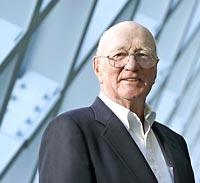
One might say Victor Gray is tilting at windmills, but that doesn't bother the 80-year-old who has taken on the state Department of Transportation (DOT) over its plan to replace the Alaskan Way Viaduct.
Officially, the department has two options on the table: replacing the viaduct with another aerial structure or with a tunnel.
But Gray has another idea: fixing the viaduct we have. He says the state could save millions of dollars and the viaduct wouldn't have to be closed for years, as the other alternatives would require. His plan is attracting a growing number of allies.
Gray claims the viaduct could be retrofitted for $800 million, far less than the $2.5 billion to $4 billion the state says it will cost to replace it.
The state, however, says repairing the viaduct would cost only 20 percent less than rebuilding it and would give the structure only an additional 35 to 50 years of useful life, compared to 75 to 100 years with a new structure.
But the state did offer one concession, spending $180,000 to hire a local consulting firm, TY Lin, to study Gray's plan. The consultant's report is due soon.
Lin reviewed an earlier retrofit proposal by Gray in 2001 and determined it wasn't wise or cost-effective to try to retrofit the aging structure.
But Gray, who for years was an engineering partner with former Gov. Dan Evans, has a passion for the viaduct.
"I'm always concerned about carefully spending the public's money," he said. "Why should something 50 years old be torn down just because it doesn't look good?"
Gray says there are 62 structural units comprising the viaduct, and that only two are damaged. "There should be a way to fix it. There wasn't that much damage," he said.
He, with his associate Neil Twelker, has proposed a system of bracing the viaduct with steel beams, adding dampers along with cement grouting of the soil to stabilize the ground against liquefaction. Gray said the work could be done while maintaining traffic on the viaduct — a prospect that has attracted fans to the proposal.
Gray, who retired in 1992, moved with his wife from Seattle's Capitol Hill, where he lived for 25 years, to Port Townsend. He golfs three days a week, walking the courses rather than using a golf cart.
A civil and structural engineer, Gray has been involved in many local projects, including the seismic strengthening at the state Capitol after a 1965 earthquake.
After the 2001 Nisqually earthquake, Gray was called back to Olympia to inspect the Capitol. A structural engineer designing a rehabilitation of the Legislative Building said Gray's work saved the building from suffering much more serious damage by adding thick concrete walls and steel beams.
Gray, a University of Washington graduate, also worked on the Freeway Park garage, the rehabilitation of the Pike Place Market, and major projects at Swedish Medical Center and Sea-Tac Airport.
"He's a superb engineer, technically far better than I was," said Evans, who met Gray when they both were graduate students at UW. They maintained their business partnership until Evans was elected governor in 1964.
"For policy reasons, people may have other reasons for tearing down the viaduct or building a tunnel," said Evans. "What Vic is trying to do is point out, if you don't have the money and need a transportation artery, you can do something for a whole lot less money than a fancy alternative scheme. This is what drives the DOT, the governor and the mayor nuts. They want something brand new.
"The worst thing in the world the state could do is put down someone as skilled an engineer as Vic is. It's demeaning for the state and state officials. Just because you don't like something, don't trash the messenger," Evans said.
Evans said he likes the tunnel idea — if there's enough money to build it. He said Gray's idea would buy the state more time to come up with the tunnel financing.
But Doug MacDonald, head of the state DOT, dismisses Gray's idea. "Everything we've been presented with has been done with magic markers on flip charts," he said. "If you want to offer as a professional ideas into this kind of discussion, you need to get past a sketch on a flip chart. The exasperating part of dealing with Vic Gray is not to know what his credentials are but to evaluate what his proposals are."
Gray has heard it all before. "McDonald said, 'Vic, go away.' I said, 'I'm not going away.' "
To bolster his case, Gray hired engineering expert Kit Miyamoto from California and paid him $26,000. Miyamoto found Gray's idea to have merit.
Why does Gray persist when the state doesn't want to listen to his ideas? "I'm stubborn. I'm saying it can be done."
Susan Gilmore: 206-464-2054 or sgilmore@seattletimes.com