Classics: Local readers relish a good debate over ancient Greek yarns
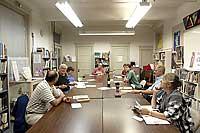
While many people were at home watching modern Greeks cheer on athletes at the Athens Olympics, a few preferred to sit in a basement meeting room at the Good Shepherd Center, engrossed in a contest between two ancient Greeks.
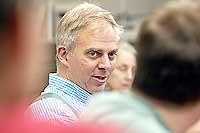
Their teacher Alan Rawn had just posed the question: Who do you prefer as the greater hero: Achilles, the brave warrior in "The Iliad;" or Odysseus, the shrewd sailor wending his way home in "The Odyssey"?
While most of us haven't pondered such a question since high school (if we ever did), Rawn's adult students and fellow members of the Northwest Classics Society relish such debates. These are not erudite snobs, nor experts, but "regular" people. And though it may not be a fashionable pursuit these days, they're happy to take a break from TV, the Internet and other modern diversions, and plunge into dusty poetic yarns spun in ancient Greece some 2,000 years ago — for no reason other than pure enjoyment.
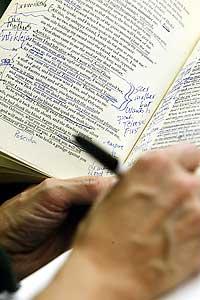
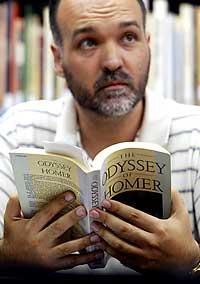
Hunched over their well-thumbed translations of Homeric texts, the students in Rawn's August class on "The Odyssey" voiced strong opinions on the two mythic figures.
Linda Hill of Bothell voted for Odysseus because "he's a husband, and a father, and a warrior and a statesman."
But Rawn pointed out that many ancient Romans considered the fabled Greek sailor a "scurrilous, conniving, out-for-himself politician." He added, with a chuckle, "Whether you prefer 'The Iliad' or 'The Odyssey' says a lot about you."
It would be hard, though, to pigeonhole the scores of people who have spent their free time taking Rawn's evening courses. It's a varied lot, as are those who've joined the Northwest Classics Society (NCS) to take advantage of the organization's lectures, book groups, movie nights and other activities (including its twice-a-year solstice parties).
Hill, for instance, is a middle-age high-school chemistry instructor who chose to take a class on Dante's "Inferno" with Rawn, "because both of my kids were reading and learning all this stuff that I wished I had known."
Trey Gorden, a young technical writer at Boeing, also got hooked on the classics through Rawn's courses. And joining Gorden and Hill in the "Odyssey" discussion were an accountant, a special-education teacher and others working in professions far removed from the seemingly rarified world of Great Books.
That was just what Rawn hoped for when he began teaching his seminar-style classes through the Experimental College of University of Washington in the mid-'90s.
"These aren't for credit, so you don't have to worry about passing tests and doing papers," Rawn explains. "They're just about reading and discussing these exquisite works of literature. To me, that's one of the best things you can do. It's really entertaining."
Hill, active in NCS for about two years, agrees. "It always surprises me when people don't enjoy this. It's just so much fun to have a bunch of people who are eager and open to learning new things, reading the same books and talking about them together."
She also appreciates the society's diversity: "This is one of the only groups I've been part of that's not one demographic. We've got male and female, single and married, young and old."
James Clauss, chairman of the Department of Classics at University of Washington, sees the value of Rawn's informal approach to heady tomes.
"I think it's great," says Clauss. "He's making them accessible to some of the people we don't reach."
Rawn's teaching style may strike some as unconventional. Openly opinionated, he's an avid debater and provocateur — egging others on to puzzle out more enigmatic passages of a text and engage in friendly arguments with him over interpretation.
But Rawn's credentials as a classicist are solid.
A fifth-generation Seattle native, he first encountered Homer as a grade-schooler reading an illustrated children's version of "The Iliad." Later, while attending Colorado College, he went to Greece on a study-abroad program and became enthralled by modern and ancient Greek language and literature.
That led to Rawn's participation in an archeological dig in Greece, and his decision to earn a doctoral degree in classics studies from UW.
After a teaching stint at University of Calgary, however, he realized formal academia was not for him. "In academia, it's not just about teaching, but research and publishing," he says. "I wasn't great at that part, so the academic thing just fizzled out for me."
Teaching freelance and at UW's Experimental College, however, Rawn found a more general interest in the classics. And his courses have expanded over the years to focus on Greek drama, Shakespeare plays, Dante's "Inferno," the Old Testament and other masterworks, as well as Greek and Latin.
In 1998, as Rawn was teaching ancient Greek around a table in a U District cafe, student Marc Bateman proposed creating a local classics society with its own space and more activities. So, with biblical literature and archaeology fan Deborah Knapp and Bateman (an accountant), Rawn formed the nonprofit NCS. Its mission statement reads, in part:
"There really is 'nothing new under the sun.' The ideas that fermented in ancient Greece, Rome and the Middle East intoxicated later civilizations. We believe that there is nothing more important than engaging with these ideas."
People turn to the classics for various reasons, however. For Hill, it was to "fill a big gap in my education." For Rawn, "It's about aesthetics. I just find this literature so beautiful and continuously interesting."
Ken Lawrence, a Bellevue special-education teacher, says hitting the great books was an extension of his love for Asian epic literature. He spent years in Japan, teaching English and studying the Noh style of theater.
Since returning to Seattle, Lawrence has taken Rawn's courses on "Gilgamesh" and "Beowulf," as well as "The Iliad" and "The Odyssey." One fringe benefit is regaling his two sons, 10 and 12, with the tales he reads.
"The stories are so magical," he says, "that I just love sharing them."
Others enjoy gleaning nuggets of timeless wisdom from the tales of Homer, Shakespeare, Dante and the like. Or relating their visions of human conflict, morality and justice to current political events. " 'The Iliad' seems especially relevant right now," Lawrence says, "because it's all about war and slaughter."
NCS members have realized their dream of publishing The Armchair Classicist, a journal/newsletter. Printed 10 times a year, it goes to about 120 subscribers and prints reviews, articles, essays by NCS members and guest academics. (Sample story: "Homer and Homers," about the parallels between the Iliadic battlefield and baseball.)
So far, however, NCS has not secured its own classroom or meeting space. An entirely volunteer organization, its financial resources are modest.
And does Rawn earn a living from sharing his knowledge of Homer, Dante, et al? "No way," he answers. "This isn't a way you make money. It's really for fun."
Misha Berson: mberson@seattletimes.com
 |
