A father's fateful quest to save family

Josephine County Undersheriff Brian Anderson sat down at a desk in a spare bedroom of his Grants Pass, Ore., home on the quiet Wednesday evening of Nov. 29. Anderson, a 46-year-old with reddish hair, flipped on the family computer.
He remembers thinking about the week ahead.
Four weeks earlier, the undersheriff had thought he'd be moving into the sheriff's office. But in early November, he lost a bitterly fought election, and he just couldn't bring himself to work for the new sheriff. Instead of moving across the hallway, he was packing up for good.
After the holidays, he'd start a new job in a neighboring county. With any luck, everything would be quiet until then.
The computer beeped as it finished booting. Anderson's eyes fell on a news bulletin about a San Francisco family that had vanished on a road trip in the Pacific Northwest. After reading that the family was headed to Gold Beach, one thought flashed through his mind: Bear Camp Road.
Anderson knew the road well. In March, he'd helped find members of a family who'd spent two weeks snowbound in their motor home after trying to take Bear Camp Road to the coast. And in 1995, he worked the case of a salesman who'd tried to take back roads from the coast to Grants Pass. Teenagers found the man's body in his pickup. He'd starved to death.
Headed home
Alternative route proves costly
About 8 p.m. on Saturday, Nov. 25, James and Kati Kim, traveling with their two daughters, Penelope, 4, and Sabine, 7 months, stopped at a Denny's in Roseburg, Ore. After dinner, they continued their trip from Seattle, where they'd celebrated Thanksgiving.
They had stopped in Portland to visit a college friend and then continued on toward Tu Tu Tun Lodge near Gold Beach, a planned stop on their trip home to San Francisco. They missed the Interstate 5 exit onto Oregon 42, the main highway to the coast. Just north of Grants Pass, they decided to try an alternate route.
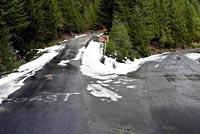
Heading west out of Merlin, Bear Camp Road runs through U.S. Bureau of Land Management and Siskiyou National Forest land. The road winds over and along steep ridges, reaching elevations of more than 4,500 feet. Much of it is one lane with occasional turnouts, and signs warn of dangerous driving conditions. Sections of the road are unpaved and often get washed out.
As their 2005 Saab station wagon climbed into the mountains, the Kims ran into heavy snow. James Kim tried to back out. Running low on gas, he headed down a BLM side road, open only because vandals had cut the lock on a gate. About 2 a.m., he reached an elevation low enough for the snow to become rain and stopped to wait out the storm. Attempts to call out with a cellphone failed. When the Kims woke later that morning, their all-wheel-drive vehicle was stuck in thick, deep snow.
The search starts
"They could be anywhere"
Brian Anderson remembers that at midmorning Thursday, Nov. 30, a Portland police officer called to ask that Josephine County deputies look for the Kims along Bear Camp Road. Anderson dispatched two deputies, who drove west through heavy snow to the crest of the road. They saw no sign of the Kims.
Meanwhile, Curry County searchers started up the same road from the east. But the snow from that direction was so thick that they made it only seven miles.
Josephine County owns two Sno-Cats, tracked vehicles that can travel over deep, soft snow. Anderson called in several search-and-rescue workers and sent one of the Sno-Cats grinding over the mountain pass. It went all the way through. Nothing.
"They could be anywhere," Anderson remembers saying of the Kims. "Anywhere."
With a final kiss ...
Father sets out for help
In the coastal mountains, it snowed heavily through Sunday, Nov. 26, and the Kims stayed in the car, occasionally running the engine to use the heater. They did the same over the next two days as snow fell on the quiet mountain.
James Kim read to his children every night, acting as if the family were just on a camping trip. The Kims melted snow in their mouths for water and rationed the few jars of baby food and jelly they had with them. When that ran out, Kati nursed both girls.
On Wednesday, Nov. 29, the family ran out of gas and started a fire using magazines as kindling, but the available wood was frozen, heavy and hard to gather. The next day, they turned to a spare tire for an afternoon fire. On Friday, they removed the four tires from their car and, by 11 a.m., had stoked a blaze they hoped would attract attention. By afternoon, the fire was out. They heard the chop of a helicopter in the distance. Then the sound grew softer and disappeared.
Saturday morning, Dec. 2, the couple studied a map and estimated the town of Galice was on a river four miles east. James Kim hoped to get to a road with cars on it or follow a river to the town. In reality, the Rogue River hamlet was 15 miles away, separated by four other steep creek drainages with treacherous terrain.
Early Saturday morning, James Kim built a fire for his family and promised he'd return by 1 p.m. if he didn't find help. Then he kissed them goodbye.
Narrowing the area
An officer steps up
Brian Anderson's home phone rang before 9 a.m. on Sunday, Dec. 3. It was Sara Rubrecht, county emergency-services manager. "Hey, boss," Anderson remembers her saying. It looks as if they've narrowed the area where that missing family might be.
At 1:45 a.m. on Sunday, Nov. 26, the night the Kims became stranded, two brief text messages had passed through a cellphone tower and were delivered to the Kims' mobile phone. A man working for Edge Wireless found records of those messages and figured the family was within 20 miles of the tower. State police also had information that the Kims last used a credit card at the Roseburg Denny's just after 8 p.m. on Nov. 25.
It was Anderson's day off. Still, she asked him whether he wanted to attend a meeting with Lt. Brian Powers of the Oregon State Police. Anderson didn't think twice, driving to the sheriff's office, where Rubrecht and a state police officer waited.
There, on a conference table, lay several maps produced by the Edge Wireless technicians. The 11-by-17-inch pages were a maze of triangles and shadings, and Anderson didn't know what to make of them.
They called a technician at home, and he drove from Medford to Grants Pass, where he explained what the shadings represented. The area included parts of Josephine, Douglas, Coos and Curry counties. At least there was someplace to search. And there was no denying a big chunk of it fell on Anderson's turf.
Up to then, no one had been clearly running the operation. "There was some frustration on the search originally," Anderson said later, "because there was no clear-cut agency in charge."
Anderson set up a command post at the Josephine County search-and-rescue headquarters and invited everyone to meet there to pull information together. They ramped up for a full search Monday morning, Dec. 4.
He knew he faced extreme pressure and scrutiny, with "a lot of eyes" watching his every move. He'd heard that James Kim's father, Spencer Kim, a powerful Korean-American businessman from Los Angeles, had flown in on a private jet and had hired private helicopters to fly over the area. National media were assembling, too, and because of James Kim's high-tech connections — he was a senior editor at CNET Networks Inc., a technology-themed Web site — the Internet was alive with comment and speculation.
Headed back
The family weakens as the hours pass
Just an hour after her husband hiked away on Saturday, Dec. 2, Kati Kim heard and saw more helicopters. The hour when her husband had promised he would return — 1 p.m. — came and went. She thought about walking out herself but realized she was too weak to carry both girls.
James Kim backtracked along the BLM road they had traveled a week earlier. Where the road crosses Big Windy Creek, he climbed down into the drainage, dropping a pair of gray pants a quarter-mile from the road. Then he continued down to the creek.
He followed the creek east, back toward the family's car. Later, he dropped several more pieces of clothing and bits of his map. He laid the clothes out in a straight line, and tucked a red T-shirt beneath a log. Deputies later found an indentation in the wet ground, where they believe he slept for a night.
Mother, kids rescued
But "where's James?"
The next morning, 100 searchers, including those flying Carson Logging Co. helicopters, swarmed the search area. At 1:45 p.m. Monday, Dec. 4, a helicopter pilot spotted Kati Kim waving a pink umbrella. Rescuers landed and picked up the mother and her daughters.
Whoops of joy rose at the command center. But the elation soon eased. "We were happy," Anderson remembers, "but we immediately refocused our thoughts on one question: 'Where's James?' "
The crews looking for James Kim had to cover steep ground blocked by downed trees, heavy brush and the occasional sheer-faced cliff. And they had to cross and recross Big Windy Creek when obstacles stopped them.
By nightfall, authorities were throwing everything they could into the search. Two Jackson County sheriff's deputies tracked Kim's footprints in the snow. Searchers in Sno-Cats drove the roads. An Oregon Air National Guard helicopter equipped with night-vision and heat-sensing equipment flew a five-mile stretch of the drainage. The sensors picked up two "hot spots." One was probably too big to be James Kim. But the other?
"We are operating under the assumption that he is alive," Anderson told the news media that evening. "We are so close."
A sign of hope?
Searchers optimistic as clothing is found
On Tuesday, Dec. 5, searchers in Windy Creek Canyon found the gray pants, setting off media speculation that, in the final stages of hypothermia, James Kim was shedding clothes because he thought he was hot. Then searchers came across two gray long-sleeved shirts, a red short-sleeved T-shirt, a wool sock, a girl's blue skirt and pieces of an Oregon map, all deliberately lined up.
It was good news, Anderson remembers thinking. James Kim was still moving. "But it was so frustrating," Anderson said. "We just couldn't seem to get in front of him."
That afternoon, Anderson received a call from Spencer Kim. He wanted to come to the command center to see what was going on. State police troopers sneaked him past throngs of reporters and photographers by having him duck down in the back of a squad car.
The command center grew silent when Spencer Kim walked in. Small, but with a commanding presence, he approached those staffing the post, looked in their eyes one by one and said, "I am Mr. Kim. Thank you."
Even though this was Anderson's command center, the undersheriff remembers that Spencer Kim came across as the one in charge. All his resources, Spencer Kim said, were at the search team's disposal.
The searchers told him about the items they'd found. "I know my son," he said. "I know what he's trying to do."
Then he turned and looked at Anderson and Lt. Powers. "I'm counting on you," he said.
Moment of silence
Rescue workers confirm tragedy
The next morning, Anderson was frantic to get helicopters back into the air. But thick fog brought everything to a halt until midmorning. Not long after the first helicopter lifted off, rescue workers spotted a motionless form in Windy Creek Canyon.
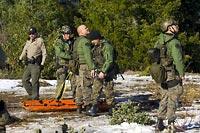
A Carson helicopter dangled Jackson County SWAT team members Grant Forman and Rick Mendenhall about 100 feet above where James Kim was spotted. They gripped the bright yellow rope tightly as they were lowered into the gorge.
Forman, scanning the scene from the air, concluded Kim was dead and called in what they'd seen. Anderson heard the dispatch, and the room fell silent around him.
"Subject located." It was the prearranged code that meant James Kim had been found dead. If he'd been alive, the code called for "subject located — we need medical."
Kim lay motionless in a shallow pool of water, his head brushing against a rock and his body slightly submerged in Windy Creek's clear waters.
News reports went out almost immediately. Anderson worried that Kati Kim would hear about her husband's death on television, and he frantically tried to arrange for somebody to deliver the message face to face. His fears were well-placed. The news flashed on the screen of a TV in the room where Kati was waiting with a friend. The friend saw the flash, but Kati missed it, and the friend quickly turned off the set.
About an hour later, Anderson stood before a throng of reporters and issued what would be his last official statement with the Josephine County Sheriff's Office: "At 12:03 today, the body of James Kim was found in the Big Windy Creek."
It was the only sentence Anderson could muster. He broke down, dropped his head, and turned from the bank of microphones to hide his tears.
Reporter David Austin of The Oregonian contributed to this report.