Books in Brief
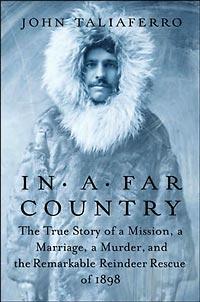
"In a Far Country: The True Story of a Mission, a Marriage, a Murder and the Remarkable Reindeer Rescue of 1898"
by John Taliaferro
PublicAffairs, 400 pp., $26.95
Tom Lopp, who ended his days in Seattle, is the glue that holds this sprawling book about late 19th-century Alaska together. But how could any book about Alaska not sprawl? The alliterative subtitle hardly does the work justice. Also covered are the Yukon Gold Rush; whaling in the Bering Sea; Inuit customs; the introduction of reindeer from Siberia; the arrival of Laplanders to teach herding; and the role of Captain Michael Healy, son of a white man and a black slave, who passed as white and who sailed one of the U.S. Revenue Cutter Service ships up and down the coast, delivering people and supplies, keeping order and effecting rescues until he was eventually court-martialed for drinking and brutality.
Throughout "In a Far Country," a historical narrative of good intentions, greed and cold weather, the estimable Tom Lopp and his equally dauntless wife, Ellen, remain the moral pivots. Missionaries both, who met and wed in the isolated settlement of Cape Prince of Wales, they taught a generation of native Alaskans to read, write and pray. While their fellow missionary, Harrison Thornton, remained paternalistic and slightly unhinged, the Lopps took to local food and encouraged their many children to speak the language. Lopp also looked for ways to encourage Inuit self-sufficiency.
Wild caribou in Alaska were increasingly scarce; domesticated reindeer across the strait on Russia's Chukchi Peninsula were abundant and trained to pull sleds and carry loads. Congress was eventually persuaded to put money into a reindeer program for Alaska, and Lopp played a significant role in creating a project to import reindeer and teach the Eskimos to herd. Eventually another missionary went to Norway several times and brought back several Lapp families to help with instruction. On one journey their reindeer came with them. One of Seattle's sadder stories is how the reindeer, who eat mainly moss, were pastured in Woodland Park and died from a purely grass diet.
In 1898, Lopp was called upon to lead a winter-relief expedition 700 miles north to Barrow, to bring reindeer to feed 200 whalers whose ships had become trapped in the ice. Although Taliaferro uses this exciting tale to frame his book, it's only part of the story. Wisely, the author focuses on Tom and Ellen Lopp, and through their eyes we catch glimpses of the Alaskan frontier at a time of enormous change.
Reviewed by Barbara Sjoholm
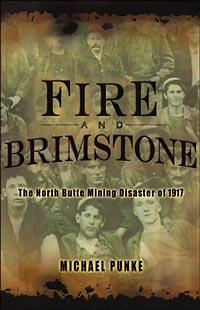
"Fire and Brimstone: The North Butte Mining Disaster of 1917"
by Michael Punke
Hyperion, 338 pp., $24.95
When fire breaks out, especially in the narrow confines of an underground mine, the natural desire is to try to escape. Manus Duggan and J.D. Moore became heroes by recognizing the need to do just the opposite.
More than 2,000 feet below ground, fire erupted in the Granite Mountain mine in Butte, Mont., on June 8, 1917. Flame, smoke and poisonous gas killed 163 miners in what has been called the worst hard-rock mining disaster in U.S. history.
In his book "Fire and Brimstone," Michael Punke carefully describes how the blaze broke out, the efforts of miners to fight the fire and to escape from it, and how some died and some were able to survive.
In addition, Punke sets the events in the context of the time — the battles between industry and unions accompanied by an atmosphere of hysteria prompted by rumors of foreign spies and saboteurs as the nation was entering World War I.
But the most riveting dramas take place thousands of feet below the ground as groups of miners working in a warren of tunnels and interconnections try to save their lives.
Duggan was a "nipper," a relatively low-level job that involved going through the mines to collect tools for sharpening. It was a job that gave him a detailed knowledge of the mine, much better than would be had by men working in only one area.
Facing fire in seemingly every direction, Duggan collected nearly two dozen miners at a dead-end tunnel where they walled themselves in, stuffing cracks with their clothing, hoping the fresh air inside would last until rescue came.
Hours passed into days, the air would no longer keep their candles lit and men began to pass out from lack of oxygen and water.
Duggan prevented several efforts to leave. He checked the air outside their wall regularly and after 36 hours announced "now is the time." The men walked and crawled a quarter-mile to a lift station and pulled the bell cord. Whether they were able to send the emergency nine-bell signal is not known, but the hoistman got the message and sent down the cage carrying rescuers in breathing helmets — a sight that frightened some of the semi-delirious miners.
Duggan went back, perhaps looking for men who weren't able to walk, while the others were lifted to the surface and medical aid.
A few thousand feet away, a half-dozen men led by Moore also had walled themselves in, saving the lives of most when rescue came after 55 hours.
One dazed miner, Martin Garrity, was revived with a whiff of ammonia and then coffee.
"What day is it, Friday?" he asked.
"Monday," came the response.
"This has been a double shift," said Garrity. "Maybe we will get double time."
Reviewed by Randolph E. Schmid, The Associated Press