Risking It All
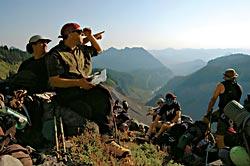
THROUGHOUT THE early morning there had been the distant thunder of shifting boulders somewhere on the mountain. The team of international climbers had hiked through the night and reached Mount Rainier's summit at dawn. Now they were climbing down, back to Paradise, back to beer and burgers, showers and sleep.
When the sound came again, first it was a rumble. Then a shivering crack, followed by an avalanche of falling ice and rocks. Wearing helmets, crampons and roped three together for safety, the teams considered running, then froze. Realizing they were not in the fall line, they watched as an acre-sized mass of ice, 50 feet thick, broke off the glacier just above them and collapsed with a roar and a blast of wind.
When it was over there was nothing left but ice dust drifting through the frigid air.
"Thank God no one was killed," their veteran climbing guide, Dan Mazur, said later. The same thing happened in 1978, but the climbers on Rainier that time weren't so lucky.
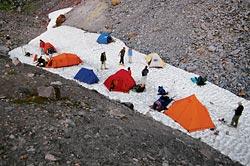
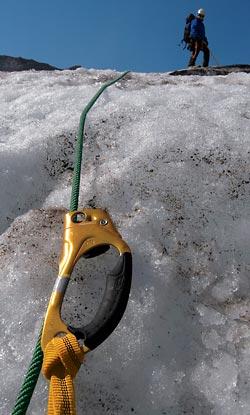
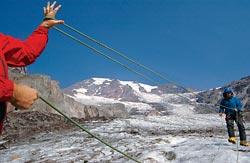
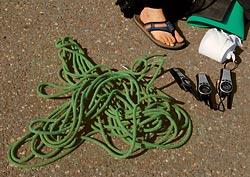
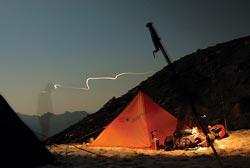
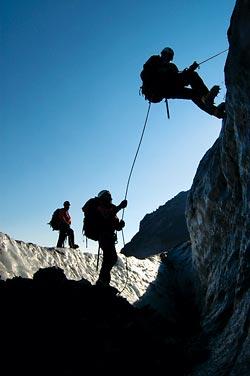
Mazur and his party of 12 had been on the mountain all week, trying out crampons and practicing with axes, rappelling down ice cliffs, crossing snow bridges, scrambling up sheer, frozen walls. At night they slept in tents on the snow, lulled by a stream song as the face of Rainier seemed close and benevolent in the late-summer moonlight.
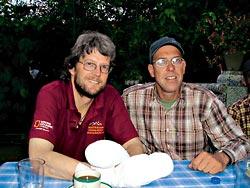
Twice a year, Mazur takes a group to Glacier School for free to teach mountaineering techniques. While Mazur, 45, invites some along just to promote the sport, others are serious climbers who someday want to attempt Mount Everest or other major peaks. Mazur hopes they'll return as paying customers with his guide service, SummitClimb. But before he'll take them on, he wants to know their abilities. After losing 23 friends to mountaineering accidents and helping rescue many others, Mazur knows how unforgiving a mountain can be. And how alluring.
Despite the danger that's part of trekking up mountains from Rainier to Everest, climbers are willing to risk their lives for the rush of adrenalin, the feeling of accomplishment, a few photos as proof of having been at the top of the world.
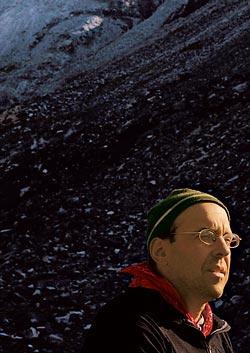
For Mazur, a tall, lanky man who lives in a beachfront home in Olympia and has a doctorate in social policy, climbing to a mountain's summit represents far more.
A summit is a faraway place attained only by the power of his own body, somewhere he can stand in awe of all creation and look down on what was left behind. It's a place to put being human in proportion with the rest of the world, to nestle in as part of the whole. A summit is a place where time passes quickly because the stay there is brief — as it is in life itself. He knows he will eventually leave and must cherish what he has while he's there.
"I love it up here," Mazur said one evening as the sun was setting beyond the silver ribbon of river winding down from the glaciers. "I could spend all my life here."
Last May, the unassuming Mazur suddenly got international attention when his path crossed Lincoln Hall's on Mount Everest. Mazur gave up his and his two companions' summit attempts with only two hours of climbing to go in order to rescue the dying Australian climber. In the goal-oriented commercial world of Everest climbing, where many clients want guarantees of reaching the summit and may even sue if they fail, rescuing Hall may be costing Mazur some opportunities. He says the number of climbers booking with him is down, but he hopes the trend will reverse itself in time for the spring Everest climb. Whether or not he has paid an economic price for his heroics, anyone who knows Mazur wouldn't expect he'd do anything less.
"I couldn't live with myself if I had walked past and let him die," Mazur says now.
About a week before, some 40 climbers had done just that to English adventurer David Sharp.
UNTIL RECENTLY there was only one choice when it came to assisting other climbers in need: Human life always trumped personal glory. But more and more people are paying big bucks for the privilege of risking their necks — anywhere from $17,000 to $65,000 to get to the top of Everest. That commercialization — especially in low-budget arrangements with little structure — has turned climbing into a less personal world where those on the mountain feel less connection to each other and, in the end, less responsibility, says veteran Everest climber Ed Viesturs of Bainbridge Island.
In stopping to assist Hall, Mazur did the right thing, Viesturs says. Something that should be routine. And yet . . .
On the frigid, sunny morning Mazur found Hall — hatless, gloveless, his jacket unzipped — sitting precariously on a ridge, he was stunned.
"I imagine you're surprised to see me here," Hall said.
"We are surprised. Where did you come from?" Mazur replied. He couldn't believe Hall was alone and alive — having spent the night without shelter, food or oxygen in 20- to 30-below-zero temperatures at the 28,000-foot level of Everest.
Mindful of the narrow window of opportunity for summiting, Mazur and his team gave Hall hot tea, their snacks and oxygen and contacted base camp. But it was difficult to convince Hall's team that he was alive. Suffering from brain swelling, Hall appeared to be dead when his team left him the day before.
With the time for summiting rapidly ticking away and the afternoon storms moving in, Mazur and his team waited in frustration — often wrestling with Hall, who was hallucinating and tried to jump off the cliff — until others could climb up from base camp to take over. An Italian climbing team passed on their way to the summit without stopping.
Hours later, the climbers arrived from base camp. It was too late for Mazur's team to continue up.
"We didn't discuss the decision to help. We all knew what we had to do," he says. While Mazur had summited Everest before, it would have been a first for the others. At the time, "I really wished we hadn't found him there," Mazur says, but "since we did, there was only one choice."
Anyone can get into trouble on Everest. And many of those who die there have been among the fittest — including Seattle's Scott Fischer, who perished on Everest in 1996.
Viesturs, who was on the mountain then, predicts that more climbers may be left behind to die as long as "summit fever" — the willingness to summit at all costs — obscures concern for others.
"I don't see it changing. People will continue to do as they do," he says. "You can't teach them morals. You can't teach them ethics. You either have them or you don't.
"Even if there is nothing you can do," he says, "you can sit by a dying man and hold his hand for the time he has left."
In 1992, Viesturs, Fischer, Briton Jonathan Pratt and Mazur were on the same climbing team, making a historic attempt on the Abruzzi Ridge on Pakistan's K2, the world's second-highest peak. Pratt and Mazur became involved in two different rescues, tying them up for days while weather worsened and their summiting energy drained.
Viesturs and Fischer in the meantime trudged on through the storms to reach the summit and climbing stardom.
Unfazed by the defeat, Mazur continued climbing in his quiet, steady manner, ticking off peak after peak, conquering seven of the world's 14 summits over 8,000 meters, reaching with Pratt the summit of K2 by the west ridge, something that had been done only once before, and climbing new routes such as China's Mustagh-Ata's west side, where Mazur and his teammates made climbing history in 2000.
Year by year. Footstep by footstep. Glacier by glacier. Mazur has evolved into one of the world's most successful climbers, those in mountaineering acknowledge. But due to his humble, self-effacing manner, until recently he was unknown outside climbing circles and still isn't likely to be appearing on a breakfast cereal box.
In a far wider arena, Mazur stands for more than bagging summits.
His self-sacrificing in the Lincoln Hall rescue garnered him praise as a role model for ethics just when dishonesty and selfishness from the classroom to the boardroom seemed to be making inroads as an accepted standard of American life.
That doing the right thing should be so noteworthy astounds Andrew Brash, who was with Mazur and Myles Osborne on Everest when they met Hall. "I'm still disappointed" in not getting to summit, says Brash, a 38-year-old teacher from Alberta, Canada. "But no question it was the right choice."
After the Hall rescue, Mazur received congratulatory letters from Gov. Christine Gregoire, Secretary of State Condoleezza Rice and several congressmen, as well as hundreds of e-mails from the public.
National Geographic Adventure is honoring him in an upcoming magazine. But his business guiding clients to the top of Everest and other major peaks has lagged. Mazur, who lives with his longtime girlfriend, Liz Carr, a marine biologist, fills the gaps by working construction jobs.
Carr, who has known him since they were in college, has learned to cope with the risks of Mazur's vocation.
"I realize that loving him means having to accept this," she says. Yet, she used to check online news of his climbs in progress "like it was the stock market." Then she decided to worry less and trust more.
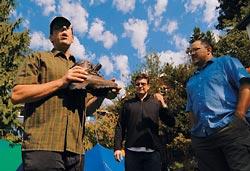
She's come to enjoy even some of the things other women might find challenging — such as having a dozen strangers from around the world camping in the backyard, all waiting for Mazur to lead them on a free climbing expedition. And she admires Mazur for many things, but especially for his compassion. He started the Mount Everest Foundation for Sustainable Development (www.summitclimb.com) and is devoted to raising money for medical clinics in Nepal, never missing a chance to ask for contributions.
Whenever Mazur leaves for a climb, he writes Carr a letter that is to remain sealed, unless he does not come back. That way, she says, "I'll have something."
ONCE A SKINNY kid with glasses from a Chicago suburb in the flat Midwest, Mazur grew up on his grandfather's stories of homesteading near Missoula, Mont. His grandfather cut trees and floated them down the Kootenai River to make a log cabin, once ran out of food and was sustained only by a bottle of whiskey, teetering on the edge of survival.
Mazur, a gangly, unhappy teenager, romanticized the challenges of the natural world, preferring them over navigating the social labyrinth of suburban Deerfield, Ill., where he worked a variety of after-school jobs.
As he took orders for appliance repair, stocked shelves or delivered newspapers, he dreamed of faraway places where he would fit in. He ran miles, strengthening his muscles and developing his stamina, which would eventually serve him well getting to mountain tops.
After graduating from high school, he went to the University of Montana and fell in love with the icy peaks that surrounded Missoula. He climbed his first mountain — Mount Sentinel — at 17.
"When I reached the summit, I felt surprised to be up there and was really taken aback by the view. It was amazing how much I could see, and the town that I thought was so huge was so small. Suddenly I could see all of the mountains around the valley for the first time. I could see all of the big clouds and the vast sky. I felt like I was flying, but I did it with my own legs. I felt so happy and elated, I wanted to smile and laugh, and I felt like hugging someone," he recalls.
"I remember the howling sound of the wind, and the fresh, crisp smell of the tamarack trees in autumn. I saw a hawk circling for a while, then set its wings straight and got whisked away into the far horizon. I felt so small and inconsequential. It was humbling."
Mazur began climbing seriously in the late 1980s, twice summiting Alaska's Mount McKinley and the Yukon's Mount Steele.
In 1990, he summited the 22,831-foot Aconcagua in the Andes. The following year, he misdirected a student loan and took a trip, spending six weeks climbing the 23,304-foot Korjenevskaya in Tajikistan and afterward buying a ticket to Kathmandu, Nepal, hoping to connect with a climbing team bound for Everest.
He ended up on Anatoli Bukreev's team, paired with Roman Giutashvili, 54, the oldest member. When Giutashvili was close to the summit but failing, Mazur encouraged him to continue, and the two finally made the top at 5:20 p.m. on Oct. 10, 1991.
For Mazur, the boy from the Midwest, it was the fulfillment of a dream.
"When you are on top of Everest . . . the clock is really ticking up there. You have to go down, but you drink in the howling . . . wind, the deep blue sky. It's just such a special place to be . . . It's time to say prayers of thanks . . . We are only halfway."
As they retreated in the dark it began to snow, and the velocity of the wind increased. By 8 p.m. Giutashvili collapsed. Mazur tried to carry him, and when he was no longer able, gave him his oxygen, dug a snow hole, placed him inside and began hiking down the mountain toward faint lights in the distance. His headlamp was out. The wind sandblasted his bare cheeks. When, several hours later, he stumbled inside the tent of his Russian teammates, he told them that Giutashvili needed help. One teammate went to find him, but came back alone.
"That's when I started to weep. I knew I had killed him. I never should have encouraged him to go on," Mazur says.
Then, another teammate set out. Several hours passed. Finally, the searcher appeared, dragging the frostbitten Giutashvili into the tent. It was only later when a fully recovered Giutashvili told a stunned Mazur that, due to a childhood illness, he had only one lung.
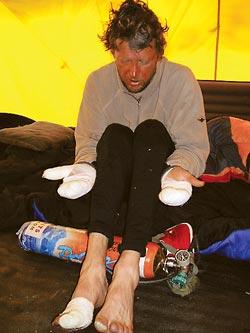
Mazur also had a close call, having developed brain swelling — common at high altitudes — while climbing on Mustagh-Aha in 2000. While in a confused state, he fell headfirst down a vertical slope but miraculously was not hurt. In 1996, Mazur had to self-amputate the tip of a toe to prevent the spread of gangrene after it was severely frostbitten in a 23-hour climb to the Lhotse Summit, Everest's neighbor and the fourth-highest mountain on Earth.
TO THE CLIMBERS who came from England, Australia, Germany and around the United States just to attend Mazur's Glacier School, he's the stuff of legends.
Giovanni Orbita, 41, and Erik Koehler, 40, both of Minnesota, registered for the class because they knew of Mazur's reputation. Then in May when they heard about the Lincoln Hall rescue, they were doubly impressed.
"We just had to meet this gentleman," Orbita said one night after a hard day of training. "To me it's more noble to save a man's life. You don't see that too often — someone who will take under consideration someone else's concerns."
Robert Kearney, who'd traveled from England to explore his interest in climbing, was equally impressed. "If all the people we meet in mountain climbing conducted themselves like Dan did, it would make me want to pursue the sport even more."
He and a friend found many guides willing to take them on Everest climbs despite their relative inexperience, Kearney said, but Mazur wouldn't even consider it "unless he'd checked us out and knew how well we climbed. He thought of safety more than making money."
That last day on Rainier the moon rose in a violet sky over the serrated ridge of the Tatoosh Range. Mazur walked alongside Orbita, who was suffering pain in a previously injured knee and limped down the trail far behind the others.
No matter to Mazur. It was enough to have spent time in that special place, and to be coming out again, having given thanks for the chance. Every time Mazur sees the mountain he feels "a comfort, knowing it's there with all its grace and mighty power."
Leaving it is leaving a friend, he said. Coming back is coming home again.
Nancy Bartley is a Seattle Times staff writer. Erika Schultz is a Times staff photographer.
A record of achievement


The world's major peaks (over 26,240 feet) that Mazur has summited are:
Everest, 1991
K2, 1993
Makalu, 1995
Lhotse, 1996
Cho Oyu, 2000
Gasherbrum 1, 1994
Shishapangma, 2001
He failed to summit Gasherbrum 2 in 1998, Manaslu in 2003, K2 in 1992 and Everest in 2004 and 2005, but has summited many other difficult peaks and pioneered new routes.