Dick Moody, 89, chronicler of a city in transition
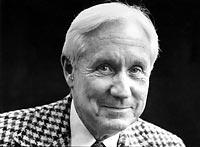
From his reporting post at the 1962 World's Fair, Dick Moody saw Seattle transform into the city of the future.
Mr. Moody loved watching the Space Needle go up and telling Seattle Times readers all about it. For 35 years, Mr. Moody covered crime, current events and consumer affairs for The Times.
Though he retired in 1982, Mr. Moody lived and breathed the newspaper business, said his son, Richard Moody Jr. Even up until his death this week, Mr. Moody kept up on sports and current events.
He even continued his longtime tradition of Saturday breakfasts with old newspaper cronies at the Burgermaster near University Village.
During a power outage Monday, the day before his 89th birthday, Mr. Moody fell down a staircase at his Laurelhurst home, said friend Jack Hauptli. Mr. Moody was knocked unconscious and died Wednesday.
"Dick was truly one of the good guys," Times Publisher Frank Blethen wrote in a note to co-workers. "A journalist who cared deeply about helping, serving and connecting with readers. One of the nicest, most gracious and professional members of our Times family I have ever known."
Born in Mount Sterling, Ill., Mr. Moody was one of three children raised by Gerald Moody, a bank vice president, and Beatrice Moody, a librarian. Mr. Moody was a basketball star at Monmouth College, a private Presbyterian-affiliated school about 75 miles north of his hometown.
He graduated with a degree in economics and married college classmate Harriet Rathbun. He then served as a Navy lieutenant and was deployed to Japan at the end of World War II.
Upon returning to Illinois, Mr. Moody briefly worked as a reporter at the Rock Island Argus, a newspaper south of Mount Sterling, his son said. He and his family then moved to Anaheim, Calif., where Mr. Moody worked for City News Service in Los Angeles.
Mr. Moody provided police and courts coverage for newspaper and radio stations, Hauptli said.
Tired of the heat and sunshine, Mr. Moody moved his family to Seattle. In December 1947, he was hired as a police reporter at The Seattle Times.
Former reporters Marjorie Jones and Don Duncan said Mr. Moody was so busy covering news at the police stations and at the World's Fair that he was rarely in the newsroom. Duncan joked that working as a crime reporter made Mr. Moody's hair turn prematurely white.
"He was a hard, hard worker. All the policemen loved him," Jones said. "He had a booming voice, and when he would come into the newsroom you could tell Moody's here because of his booming voice."
For 12 years, Mr. Moody reported for work at 6:30 a.m. to turn around copy for the afternoon newspaper. Mr. Moody later worked as an urban-affairs reporter, covered the World's Fair, then in 1970 took over the Troubleshooter column.
Mike Fancher, The Times' editor-at-large, said Mr. Moody was among those responsible for the Troubleshooter, a consumer-oriented column that gave readers a chance to complain about businesses, advertisers and the government.
Mr. Moody was successful with the column because he held people accountable and "had a tremendous sense of fair play," Fancher said. When Mr. Moody retired, Fancher thought about eliminating Troubleshooter but his mind quickly changed after hearing an outcry from readers. The column was finally dropped in 2000.
"He just had this elegance about him," Fancher said. "Everything about him said he was a trustworthy person."
After retiring from The Times, Mr. Moody worked as a stringer for The New York Times, focused on his tennis game and devoted love and attention to his 1969 Ford Mustang — a car he bought when it came out.
Duncan said Mr. Moody was the best tennis player in the newsroom and loved watching baseball games at the Kingdome.
"I remember when the Dome was first built, he would go up and sit in the real high area there and watch the baseball games," Duncan said. "He thought that was the best bargain in town."
Mr. Moody's wife preceded him in death. In addition to his son, who lives in Virginia, Mr. Moody is survived by two daughters. There will be no services.
Jennifer Sullivan: 206-464-8294 or jensullivan@seattletimes.com