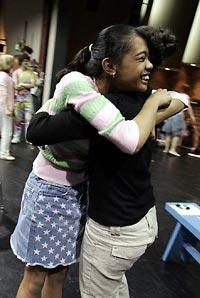
Teens approach hugging with open arms

When students at a Lynnwood alternative high school thought administrators were cracking down on hugging recently, they launched a petition drive.
Within a day, they'd gathered signatures from 80 of the school's 250 students insisting on their right to hug.
Turns out there was no ban, just concern about some hallway hugging the principal said went on too long.
But the students' sharp sense of injustice suggests just how much hugging has come to mean to adolescents. From middle school to high school, from athletes to band geeks, students are throwing their arms around each other. The hug, a greeting once reserved for young children and out-of-town relatives, is how teenagers now say hello and goodbye.
"Boys are hugging boys. Girls are hugging girls. Girls are hugging boys. They're a hugging generation," said Joyce Stewart, principal of Evergreen Middle School in Everett.
Grown men hugging each other can make the news, as when Chinese President Hu Jintao hugged a Boeing supervisor during his April visit, largely because Chinese officials are known more for formality than spontaneity.
King County Executive Ron Sims, who has made a career of hugging, sees a sort of global warming when it comes to the affectionate embrace.
"Around the world, everybody hugs," Sims said.
But in the hallways of the region's schools, all that hugging makes some administrators nervous.
"We try to discourage it," Stewart said, citing concern that such a gesture, given to the wrong person, could be interpreted as harassment or an unwanted sexual advance. Stewart said teachers at Evergreen avoid hugging students and try to prevent students from hugging them for the same reason.
At Brier-Terrace Middle School, Principal Bill Fritz said student hugs must be limited to three seconds. After three seconds, the gesture enters the red zone of Public Display of Affection.
"Some kids try to go there, but we put an end to it," Fritz said.
In the Lakewood District northwest of Marysville, students are sometimes late to class because of all the hallway hugging.
"We only have a four-minute passing period. It gets disruptive when students want to stop and hug everyone," said Lakewood Middle School Principal Crystal Knight.
So what's up with hugging? Why has it become the teenage greeting of choice? And how many variants are there?
Take a group of teenage girlfriends at the mall. Before they part company, each girl hugs every other girl. Say there are six girls. That's 15 hugs.
"Exponential hugging" is how Jason Coffman, a coach for Mount Baker Rowing Club on Lake Washington, described it. After practice this spring, the 40-some high-school girls who rowed crew hugged each other after practice. Not all of them every time, but large groups of them.
"They're very demonstrative. It's a gender thing and an age thing," he said.
At Mount Baker, the boys don't hug after crew practice. The college women he previously coached did not hug after practice. And when he last coached high-school girls for Mount Baker, they didn't hug.
"Ten years ago, they weren't as demonstrative, but they also weren't as tight-knit," Coffman said.
At Mountlake Terrace High School, an entire hallway was devoted to hugging during the recent "Care Week." Students were encouraged to hug each other as they passed to show their concern and affection. The adjacent "Wink Hall" was deemed "too cheesy" and went largely ignored, said Sharon McClintock, a freshman and self-described "hugging expert."
McClintock said hugging at Mountlake Terrace often goes with extracurricular activities.
"Students in band hug each other. Two guys in drama hug all the girls before leaving. The ASB [Associated Student Body] kids hug a lot," she said.
McClintock likened today's hugs to an earlier generation's handshakes: a greeting and an acknowledgment of familiarity, "only less formal." And there are several popular variations.
There's the "drive-by" hug, in which friends quickly grasp each other while hurrying to class.
There's the "true friend" hug, in which boys lift up girls they've known "forever" and swing them around.
There's the "fantastic news" hug, as when a good friend got admitted to culinary school. That hug, McClintock said, featured accompanying sound effects.
There's also hugging to get warm and hugging to be consoled.
"When someone's feeling bad, it's just natural that you hug them," she said.
McClintock said she may be so attuned to hugging because she attended a Christian middle school where only same-sex embraces were allowed.
"If something terrible happened to someone, you could hug them, but only from the side," she said.
Similarly, Leah Pope, a junior at Mountlake Terrace High, said her middle school allowed only "grandma hugs," with nothing touching below the shoulders.
Pope said that in high school, discomfort may arise when someone offers an exploratory, I-like-you-do-you-like-me? hug.
"That can be awkward, but life is awkward," she said.
Some see the potential for world harmony and multicultural understanding in the rise of the hug.
King County Executive Sims has embraced so many people in so many venues that he has been labeled a "serial hugger."
"I'm so well-known as a hugger that if I don't hug someone, they think I'm mad at them," he said.
Sims takes a military protocol approach to hugging. He may spontaneously hug someone of equal or lesser rank, say, a Republican county councilman, but he said he asks permission of anyone of greater rank, such as a senator or president.
He delights in recounting the story of a White House reception in which Bill Clinton shook and shook his hand and would not let go. Finally the president said, "Aren't I going to get one of those famous Ron Sims hugs?"
Sims believes, as did his father, that hugs break down barriers and disarm defensiveness.
"They say, 'I'm comfortable in your space and you're accepted in mine.' "
He believes the popularity of hugging among young people is a reflection of our increasing world perspective. People here travel to countries that are more expressive and physically affectionate. People from those countries have brought their hugging here.
"I think we're going to see it take hold throughout the country," Sims said. "If everyone did it, the world would be a better place."
Lynn Thompson: 425-745-7807 or lthompson@seattletimes.com