A Stage Presence
WARNING: "Sex in Seattle" is not politically correct, not high-brow entertainment, and definitely not your grandmother's model-minority myth.
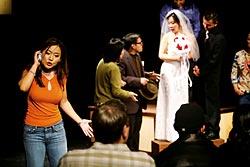
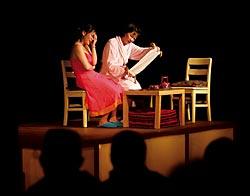
It is, however, charmingly erotic, an episodic stage production featuring karaoke and cellphones, bubble tea and 40-ouncers, tangled relationships and oozing hormones. Part sit-com, part soap opera, its four leading ladies are Asian American, but not in the usual roles. No kung-fu heroines. No World War II internees. No doctors, no lawyers, no exotic temptresses or demure geishas with down-cast eyes.
Instead, the ongoing drama revolves around a quartet of women in their late 20s: a virgin schoolteacher, a junior graphic designer, a psychic-hotline operator and a spoiled East Coast conniver who steals the virgin's fiancé. The women are, by turns, arrogant, vulnerable, insecure and horny. Between productions, they lead virtual (but not virtuous!) lives, their staged diary entries e-mailed to fans.
Excerpt from the diary of Elizabeth (the virgin — or maybe not!):
Omigosh! Omigosh!! Omigosh!!! I just want to forget that these last two days ever happened! I saw the man I love marry someone else. My first time drinking and I got a horrendous hangover. I woke up naked in a strange man's apartment. My ex-fiancé will probably never speak to me again. And now after all these years of saving myself, I might have lost my virginity without even knowing it!! Maybe I didn't really have sex? But what if I did? How will I ever face my parents again?
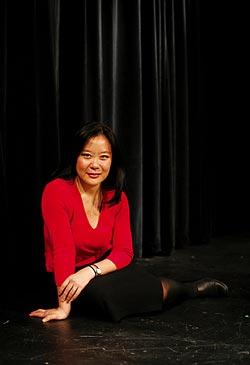
In theaters, pop culture and pro sports, Asian Americans rarely see characters they look like and identify with, says Kathy Hsieh, "Sex in Seattle" co-founder and co-producer, who writes and acts in the shows. "Most other people, growing up, you turn on the TV and you see yourself, so you feel like you belong and you're not invisible. Asian Americans and Native Americans are two groups that don't have that opportunity. . Ichiro and Yao Ming, they're not American, they're foreign-born. Asians also have the model-minority stereotype, but most of us will never be on that level. Having characters who (are not super achievers) sends the message that it's OK to be you."
The dramatic formula works. "Sex in Seattle" has acquired an almost cult-like following. In a dozen episodes over five full seasons, SIS has almost always played to sold-out houses in theaters that seat 100 or more. (Once, they had to turn away more people at the door than were in the house.) And the show's popularity is spreading. SIS has leased scripts to other theater companies, spawning "Sex in Vancouver" (B.C.)
Audience demographics: most between 20 and 40, most Asian American or a racial mix, most incredibly cool-looking: low riders, hair product, an aura that lets you know the show is just the start of their evening.
Take Jenny Ling, a 25-year-old freelance makeup artist (black tank, black leather boots, highlighted tresses), who reserved tickets for Episode 12 — "My Ultra Quirky Asian American Wedding" — after getting hooked on Episode 11 — "The Ultimate Dating Challenge."
"It's like: Oh yeah, I can see that happening. I've heard something like that before," Ling says. "There aren't a lot of performances or music or art that have, y'know, Asian people, so it's cool to see. It's Asian-American life, but it's also reality, urban life."
The audience exudes energy, sexuality, edge. They hoot, hiss, fondle. This is the kind of crowd you don't see at the Seattle Rep or Intiman. That's significant in a city where the regional-theater audience is aging and has yet to be replaced by younger blood.
"Sex in Seattle" is so trendy, the wish list in its playbill includes "ushers . . . manila folders . . . unused, unexpired condoms." There's also an advertisement from a therapist: Symptom is Opportunity — Counseling Services to Creative Individuals.
And why not? The show is all about relationships.
Excerpt from the "Sex in Seattle" playbill notes:
Tess discovers that Zane, her gay husband, is sleeping with a white woman. Meanwhile, she meets face to face with her phone-sex partner, Patrick, only to have Patrick, who's bi, fall head over heels for Zane. . . .
Elizabeth develops a friendship with George, who helps her keep an eye on Nathan, who looks like he's having an affair with Shari. Elizabeth tells Kenneth (her ex-fiancé who's now married to Shari) about her suspicions, but he doesn't believe her until he finds an empty pregnancy test in the garbage, plus Shari and Nathan together. . . .
Jenna finds herself re-attracted to Nathan, but is conflicted because of her relationship with Colin, who doesn't appreciate being in a love triangle and leaves. . . .
Tess meets Adam through The Stranger personals, but it doesn't work out because Tess is still married to gay Zane who is still with bi-Patrick. So Adam hooks up with Jenna instead, and Tess files for divorce. . . .
Harold messes around with Chloe, but proposes to Elizabeth, needing to produce a Chinese baby in order to inherit the family business. . . .
GOT THAT?
If not, don't worry, you're not slow, just behind by 12 episodes.
Six years ago, there was no "Sex in Seattle," just a few Asian-American friends, theater-types, hanging out on summer nights in a studio apartment downtown.
"We were sitting around talking about how do we learn about relationships, one of the most basic and one of the most misunderstood things in life," says Hsieh of her conversation with friends Daniel Arreola and Moi, who goes by one name. Hsieh is happily married to photographer Rick Wong; her friends were each having dating issues.
"All of our parents were first-generation immigrants, and none of them ever really talked to us about that. Growing up in North Seattle, Lake City, a lot of my friends' parents would have "The Talk" about when you were starting to be a teenager. They'd tell you about the facts of life, set rules about dating. My parents and I didn't even have the same language to talk about these issues. I speak a fourth-grade-level Mandarin, and my parents never even told me the word for dating!
"For everyone else, bad as it is, you see Brad Pitt and Jennifer Aniston. You see people who look like you, and you see that they're having relationship troubles. You read about it in People magazine. But Ming-Na (Wen, of television's "ER") or Lucy Liu (from the films "Kill Bill" and "Charlie's Angels") — we never read about them in the magazines. You almost never get to see Asian Americans having dating relationships on television and in movies," Hsieh says. If they do, it's an Asian woman with a Caucasian or African-American guy — and usually she's quickly dumped for someone else.
As for Asian guys, Hsieh says, they're too often portrayed as asexual. Look at "Star Trek": "Captain Kirk was all over the place, and Sulu never had anything!" Even kung-fu star Jackie Chan is depicted as a jokester, not a romantic lead like James Bond.
"The reality is, Asian Americans are mostly invisible in pop culture, even something as pulpy as the National Enquirer. How do you feel like you're normal when you never see or read about people like you going through the same thing you are?
"Since we're all theater people, we thought, well, shoot, why don't we write a play about relationships?"
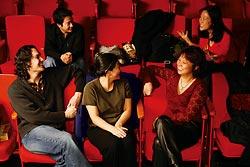
The idea quickly turned into a series and a theater-production company, SIS Productions, with a goal of showcasing the talents of Asian Americans — especially women — producing, directing, writing, acting. Fellow artists Serin Ngai and Amy Waschke joined the team as co-producers.
Hsieh, who has worked, acted and volunteered in theaters all over town since she was in high school, proposed a collaborative business model that would share leadership, decisions, tasks and profits — rather than the traditional hierarchical management found in most theater companies.
"Why mimic the white heroic male leadership model of CEO government where there's someone at the top and it all goes down from there?" she says. "Since we were a group run by women, why not try a tribal style of leadership where you have a circle and it's more collaborative and everyone's an equal."
It wasn't just political theory. If they tried to do it all themselves, Hsieh figured, the "leaders" would get burned out.
The four women dreamed up characters they'd like to play. Hsieh, always cast as "the other woman," because she never looked like the family, for once wanted to be the ingénue. Thus was born romantic lead Elizabeth, who follows her heart.
Waschke, who constantly joked about marrying her gay best friend, dreamed up Tess the Spontaneous, who reacts from her gut and married her gay best friend. Ngai and Moi created character sketches for down-to-earth Jenna, who is forever caught in dilemmas because she's so loyal to people she loves, and Shari the Sexual, who's led by her groin.
They'd never seen "Sex and the City," which had just started on HBO, but all loved the fast pace of "Friends." They imagined injecting a contemporary twist in each episode: videos, voice-overs, slide shows, shadow puppetry, karaoke or game shows to involve the audience. Eventually, SIS e-mailed characters' diaries and sketches to fans so they could tune in between episodes.
Ngai wrote the first script, a staged reading in December 2000 at the Northwest Actor's Studio, a 99-seat house. The producers funded the reading themselves, put notices in the International Examiner and Northwest Asian Weekly, and sent out about 200 postcards designed by a graphic-artist friend. Expecting mostly family and friends, they were astounded by the turnout. So many people came, they had to turn away the Seattle Weekly's reporter at the door. With $5 tickets and a $1,000 donation from an enthusiastic friend and fan, they cleared $850, enough to put on the next show.
Excerpt from Tess' diary:
It's 5:00! Why hasn't Patrick called, dammit?!?!? Nothin's worse than sitting by the phone with your pants down, waiting for a phone call. And, where the hell is Zane? I wonder if he's off seeing that Emily girl. I can't believe my luck. Of all the gay men out there, I had to marry the one that ends up being straight! Oh sheeit! My Top Ramen's boiling. PATRICK! Where are you?!?!. . . .
UNTIL A DECADE ago, America had only a few Asian-American theaters, one each in New York, Los Angeles, Honolulu, San Francisco and Seattle. Then, in the mid-1990s, the Asian-American drama scene ballooned.
Now there are 50 to 60 groups nationally, including four in Seattle: ReAct, which does multicultural, nontraditional casting of traditionally mainstream plays; Pork Filled Players, a sketch comedy troupe; the Northwest Asian American Theater (now in stasis), which staged mostly historical dramas, and "Sex in Seattle."
"All these express a different part of the Asian-American voice," says Roger Tang, founder and editor of the Asian American Theater Revue, who is also literary manager for SIS and managing producer for Pork Filled Players. " 'Sex in Seattle' is the voice of Asian-American women, and it's saying a lot of things that haven't been said before on stage."
Another excerpt from Tess' diary:
Okay. Here are my options.
Plan A: Get over the fact that Zane slept with that woman.
Plan B: Keep moping
Plan C: Confront Zane again and get more definite answers from him
Plan D: Go on a date
Plan E: Get laid
Plan F: Make another bowl of mac 'n cheese and buy a case of beer
Plan G: Wait for Patrick to call
Plan H: Masturbate
So far, I like Plans B & E the best, followed by Plan F. Plan D takes too much effort. So realistically, I should probably just do Plan H. Now.
Why the recent upsurge in Asian-American theaters?
Demographics. "Generally, you're not going to see arts until the second or third generation comes of age," Tang says. "That's when people stop struggling for survival. They have time to think about more artistic, aesthetic things."
In Seattle and other urban centers, the children and grandchildren of Asian immigrants have grown up, defied parental expectations, followed the lure of klieg lights. "Traditionally, most people would not like their kids going into the arts because it's not a tried-and-true profession. Why can't you be a lawyer or doctor?" says Tim Dang, producing artistic director for East West Players, an Asian-American theater born out of the Watts riots in Los Angeles.
Yet drama fills a social need, if not the wallets, of those who engage in it. (In fringe theater, actors and others feel lucky to take home a three-figure stipend.) "It's important to a community, to a culture. It bonds them together," Tang says. "It validates that their experiences are real and matter, gives a certain pride and self-esteem. When David Henry Hwang won his Tony for M. Butterfly, people really took it to heart. Not just the artists, but everybody in the local coffee shop."
Seeing Asian Americans on stage gives people a greater understanding of Asians as Americans, Dang says, and breaks down the usual perception of Asians as foreigners.
Dang predicts dramatic breakthroughs in the next five to 10 years. This June, East West Players will host a national Asian-American theater conference; in 2007, there will be an Asian-American theater festival in New York City.
"We're looking for the next David Henry Hwang," Dang says. And for regional theaters to produce more Asian-American scripts. For Asian-Americans to be cast in Shakespeare and Broadway musicals. For Hindu dance, Taiko drumming and Kabuki song to enhance productions of, say, "Equus."
"It's the whole thing about inclusion," he says. "You so rarely see Asian-Americans on stage, just by seeing one, that's saying something political: An Asian in the Forest of Arden!"
MEANWHILE, REAL LIFE moves on for the cast and crew of "Sex in Seattle." A founder moved to the East Coast, an executive producer went to grad school, a writer went to law school. "Sex in Seattle" absorbed a pool of Asian-American theater talent set loose when the Northwest Asian American Theater stopped producing plays. Longtime SIS fans became volunteers, sound-board operators, Web masters, executive producers.
And what of the quirky, wild, winsome foursome? At a Sunday-morning scriptwriters workshop, Hsieh hovers over the next episode:
Will sleazy, desperate Harold ever reunite with Elizabeth, who was kidnapped on their wedding night by Kenneth and George?
What will Elizabeth do when George proposes? Is she racist for not wanting to have children with him because he's white — even though he acts Asian?
Will things heat up when Tess runs into Nathan, Jenna's other ex?
When Jenna tries to make things work with Adam, what's the little surprise that gets in their way?
Plus, whatever happened to slutty, spoiled Shari, whose manicurist inspired her to go to Korea to search for her roots?
Find out in Episode 13: "Risking It All For Love," playing at Richard Hugo House in June.
Paula Bock is a Pacific Northwest magazine staff writer. She can be reached at pbock@seattletimes.com. Benjamin Benschneider is a magazine staff photographer.