18-year-old UW student named Rhodes Scholar
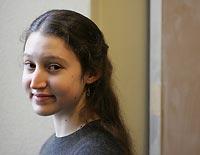
Eliana Hechter was 7 or 8 when she sat around a dinner table with students from England's prestigious Oxford University, trading riddles over the mashed potatoes.
Her contribution: What's a five-letter word ending with an "e" that's pronounced "ee" and with no vowel preceding the "e"? (The answer: maybe.)
Now, the 18-year-old University of Washington senior is preparing for a return trip to Oxford, this time as a student.
Hechter, who went straight from middle school at Seattle Country Day School to college, learned Saturday she was one of 32 people chosen from the United States as a 2006 Rhodes Scholar. She is the second-youngest ever to win the award.
"I always kind of dreamed in the back of my mind ... dreamed that I might be part of such a group. It's wonderful to be able to complete that kind of circle," said Hechter, who grew up in Seattle's Queen Anne neighborhood.
The honor is the latest achievement by a talented, poised young woman whom one of her professors described as an "absolutely incendiarily bright person."
Within the past week, she learned she had won the Marshall Scholarship, one of a pile of academic honors she has earned.
At an age when many people are preparing to graduate from high school, she's finishing a math degree at the University of Washington, writing a scientific paper about the dynamics of cell division, honing her skills as a cook and playing ultimate Frisbee. Her studies have ranged from poetry to biology.
"She has this exceptional ability to sort of synthesize all the things that she has learned into this sort of full-bandwidth vision of how the world works," said professor Garrett Odell, director of the UW's Center for Cell Dynamics.
Odell first met Hechter when she was a 16-year-old student, taking part in an intensive course at the center. Odell, himself a mathematician, was struck by her intuitive mathematical insights. She rewrote his lecture notes after concluding they could be made more understandable to people not as fluent in math, he said.
Yet, she told Odell that she wasn't good at math.
During her first year at the university, at 14, an instructor told her to stick with creative writing.
"I think he just thought I didn't have the talent to hack it. He's now in ministry school in Chicago. He decided math wasn't for him," said Hechter. "The irony does not escape me."
With Odell's encouragement she turned her attention to math and now plans to pursue the field at Oxford.
Hechter's precociousness was apparent even as a young child. She was speaking in full sentences at age 1, said her mother, Debra Friedman. Friedman recalled being told by a kindergarten teacher that working with her daughter was "the pinnacle of her experience as a teacher."
"She was intensely curious and very verbal at a very early age. She always loved learning," Friedman said.
Hechter grew up in a household filled with scholarly conversations.
Her mother and her father, Michael Hechter, were both sociologists and college professors. This year they moved to Phoenix, where she is dean of the College of Public Programs at Arizona State University and he is a professor of global studies, specializing in nationalism and ethnic conflict. Her father was a lecturer at Oxford for several years. That's when the younger Hechter first spent time at the school.
Friedman said they set high expectations for their daughter. But that wasn't hard.
"We just tried to keep up," Friedman said.
Warren Cornwall: 206-464-2311 or wcornwall@seattletimes.com