Steinbeck's timeless tale of Joad family revisited
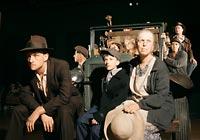
Before watching "The Grapes of Wrath" at Intiman Theatre, it can't hurt to pore over the classic John Steinbeck novel which Frank Galati reshaped into a Tony Award-honored play more than decade ago.
But to really get into the spirit of the show, look to some significant portions of the Old and New Testaments.
In the story's aphoristic dialogue, stark imagery of suffering and redemption, and the restrained simplicity of Linda Hartzell's staging, "Grapes of Wrath" reveals itself here as an enduring parable rather than the gritty Depression-era exposé one might expect.
And as the humble Joad family leaves their ruined Oklahoma farm for the promised land of California in the 1930s, they evoke not only the homeless, wandering survivors of recent hurricanes, but also the biblical Job clan and the plague-fleeing Israelites in Exodus.
On the sparely dressed Intiman stage, with sounds of the brutal Oklahoma wind whistling behind him, young Tom Joad (played by Erick Kastel) comes home after a jail stint of several years.
He finds his ancestral farm bulldozed by a faceless corporation. And his rock-solid Ma (Beth Dixon), fretful Pa (Patrick Husted), pregnant sister Rose of Sharon (Autumn Dornfeld) and other relations ready to hit the road.
With the optimistic stoicism of those with no choice, the Joads cram what they can into a beat-up Hudson truck and head out to Route 66. And en route to California, they find an America none too friendly to its dispossessed.
Gas-station attendants snickeringly mock these hard-working "Okies" as dirt-stupid hicks. California growers exploit them as a dirt-cheap labor. Dirty-dealing security thugs in the "Hoovervilles" (transient camps) beat and brand them as "Reds" if they get too uppity. The Joad family inevitably splinters apart, but its members endure — because, as Ma stresses, "We got to."
All this, and the righteous anger that replaces meekness with protest and labor organizing, is conveyed respectfully, with a minimum of cornpone and bluster by the large Intiman cast. Aided by Carey Wong's minimalist settings and Mary Louise Geiger's excellent lighting, Hartzell unpacks the episodic story with great care, like you would an old trunk full of worn, precious family mementos.
There is dignity, clarity and scant hokum in her approach. And the play's ending (from the book, not the John Ford film), with its Pieta image of sacrifice and rebirth, is profoundly moving.
But if anything, Intiman's "Grapes of Wrath" is almost too austere and reverential, despite the odd gust of earthy humor. Some loaded incidents are so muted, they're nearly thrown away. And several key actors need to bust out more, to give the black-and-gray shadings more bursts of color and personality.
There can be no quarrel with Todd Jefferson Moore's marvelously folksy and soulful portrayal of Jim Casy. Jim's a preacher who's lost his religion but becomes the prophet of Steinbeck's vigorous, humane populism.
With her husky, scraping voice, staunch hardiness and unshakable decency, Dixon also rings true as the iconic Ma Joad.
Husted's Pa and Russell Hodgkinson's Uncle John eventually gain some distinction, too. And several utility players (including Shawn Telford, Bradford Farwell and Josephine Howell) dispatch multiple roles well. But Kastel and Dornfeld, especially, need to loosen and spice up their bland sincerity.
The occasional songs (hymns, ad jingles, '30s folk tunes) performed by the cast are important mood-setters and history-markers. If only Intiman could scrap the taped instrumental backup.
Even a lone troubadour guitarist, to accompany and comment, would add a lot to this American family chronicle, which resonates with other great primal family sagas through the ages.
Misha Berson: mberson@seattletimes.com
Now playing
"THE GRAPES OF WRATH," by John Steinbeck, adapted by Frank Galati. Tuesday-Sunday through Nov. 13 at Intiman Theatre, Seattle Center. $27-$46. 206-269-1900 or www.intiman.org.