Notebook: Tradition stitched together
When Kamiak High School opened in 1993, there was no history. For the athletic department, that meant no trophies, no players who had gone on to bigger and better things, and no tradition.
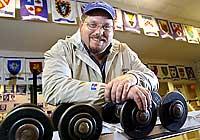
That made it the perfect place for Ron Hadley's long-standing interests to bloom. Hadley, 41, who played football at the University of Washington, has always been fascinated with medieval times — knights, castles, jousting tournaments.
After taking an assistant-coaching job at Kamiak, which had adopted Knights as a nickname, Hadley and some school boosters approached then-Coach Tim Mead with the idea of making a coat of arms for each football letterman.
"We were just trying to form something that signified the knight, the honor of being a knight, being a gentleman, a good citizen, a good student, as well as working hard and being strong of character," Hadley says. "Those are all the things that we try to exemplify in our football program."
Hadley proposed doing the research and design. A local company donated high-quality backpack fabric. Parents and relatives volunteered to cut and sew patterns.
Mead gave the go-ahead. And a tradition was born.
The result, more than 10 years later, is impressive. The Mukilteo school's weight room is filled with almost 300 2-by-2-1/2-foot banners.
Each is a distinct design placed on a shield relating to the athlete's last name or heritage. But they all rest on purple or white backgrounds, signifying the school colors and the program's unity.
Some designs are traditional. Former quarterback John Mack, the son of the current coach, Dan Mack, traces his lineage to an ancient Irish clan that represents itself with a wyvern, a mythical dragon that guards treasures. Mack's crest bears that creature.
Some designs include references to family. Junior running back and linebacker Josh Reed is the last of eight Reeds, brothers and cousins, to play football at Kamiak. Each of their crests includes a bundle of wheat.
First-born sons have a crown stitched atop their crests. Second-born sons are signified by crescents. Third-born sons by a swallow.
Some designs are unique. Senior lineman Joe Huss is half Lakota Sioux, so his crest includes an eagle feather and a great white buffalo skull, important symbols in his culture's folklore.
A Filipino player's crest incorporates the colors of his native country's flag. Another player, nicknamed "Tex," has a lone star on his crest. A Korean player named Chung displays the Korean character for his name next to a bow because of the sound it makes when it lets loose an arrow.
"The fun part is looking them up," Hadley says, "creating something if it doesn't exist. Finding out what the names mean."
Hadley figures it takes about four to five hours to research and produce each crest. Hadley tries to finish a team's set by the following spring. He insists he's not artistic.
The banners are considered an honor, something to be earned. And not just on Friday nights.
"If you've been in the program, if you've made a contribution at practice, if you've been a great scout player, that JV player is just as important to the team winning because he's the guy that gets everybody prepared," Hadley says. "That's a valuable role on our team."
In that spirit, team accomplishments such as conference championships and playoff appearances are patched onto each banner. Individual honors are not allowed.
"It really is a rallying point for alumni to come back to the weight room, and when they come in, they tell stories to our younger kids about when they were playing here at Kamiak and some of the memories they had," Coach Mack says. "It's a real nice tie, and it brings a nice continuity to our football program."
A few banners have come down quietly, Hadley says, because some of the kids "haven't lived up to the character or standard they needed to."
Any player who received a banner the previous year gets to carry it out on the field before each football game and hang it on a rack on the sidelines.
Last week, Hadley stood in the middle of the locker room, looking at the banners and pointing out kids he had coached.
Pat Bookey graduated ninth in his class at the Naval Academy and just received a scholarship to Massachusetts Institute of Technology. Jerry Matson is a captain on the University of Oregon football team. Brandon Christensen is an assistant football coach at Shorecrest High School in Shoreline. This year's group, which lost Saturday to Skyline of Sammamish 28-21 in the Class 4A state quarterfinals, also had some memorable players.
"A lot of great leaders, strong characters," Hadley says of many of Kamiak's players. "All those guys came in here and started exactly the same as everybody else."
Dad gets soccer news while covering football
While Archbishop Murphy freshman soccer player Emma Nelson was competing in the Class 2A state-championship game Saturday night, her father, Chuck, was in Pullman working.
The University of Washington kicker from 1980 to 1982 provided color commentary for the 97th Apple Cup, the annual UW versus Washington State football game, for radio and television.
Both games started at 4 p.m. Emma Nelson said her mother, Nanette, had to send scoring updates via cellphone to her father.
"He was really sad that he couldn't come to my game," said Emma, a starting midfielder for the private school near Mill Creek. "I had to teach my mom how to send text messages so she could send them when someone scored."
Unfortunately for the Nelsons, most of the news was bad. Naches, a Yakima-area school, beat Archbishop Murphy 3-1. Senior Kat Taylor scored Archbishop's lone goal on a bending corner kick late in the game. She finished her remarkable high-school career with 143 goals.
Around the county
• Lake Stevens High School is accepting applications for head football coach after Ken Collins resigned last week.
Collins coached at Lake Stevens for 15 years, leading the Vikings to six WesCo North championships and seven trips to the state playoffs. In 1994, Lake Stevens lost to O'Dea in the Class 3A state championship.
Seattle Times correspondent Matt Massey contributed to this report. Michael Ko: 206-515-5653 or mko@seattletimes.com