Her warning allowed hundreds to flee Nazis, hide in Arctic caves
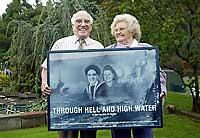
Nancy Kelly thinks often of that winter she spent in a cramped cave in the Arctic, hiding from Nazis and surviving on dried meat, lingonberries, melted snow — and pluck.
Now 81 and living in Renton with the Scottish-born husband who rescued her when they both were 21 — she was a legal secretary for the Norwegian police and he was a British sailor — Kelly often has told her story to their grandchildren:
How she and six other hardy Norwegians quietly passed time in the cave playing cards or listening to newscasts on a forbidden radio that linked them to the world beyond. How they whispered stories that mocked the Nazis who had burned their centuries-old village. How they took a thin branch, bored it with holes and decorated it with scraps of foil — their Christmas tree in 1944.
How, despite such wretched circumstances, "we were a happy bunch. We looked at the funny things that happened," refusing to be defeated and cherishing the moment.
"Everyone got along," she said.
Kelly and some 500 other Norwegians survived the Nazis by hiding for months in seacoast caves on the island of Sørøya, in Norway's most remote region, which was under Nazi occupation.
That any were able to hide at all is due to Kelly, who passed on to villagers classified information she picked up at police headquarters about plans by the Nazis to burn entire villages rather than allow them to be claimed by approaching Russians.
Her warnings made it possible for the townspeople to prepare food and gather other supplies before fleeing for the hillside caves.
Though largely unknown in this country, her story has been made into a documentary, "Through Hell and High Water."
The 90-minute film has been shown throughout Europe and broadcast on the United Kingdom's History Channel, and is playing for the first time in the United States in a sold-out showing today at the Nordic Heritage Museum in Ballard.
Terje Leiren, a Scandinavian-studies professor at the University of Washington, said the war made heroes out of many, calling on people to test themselves often and in many ways.
Those in northern Norway — where the climate is harsh and daylight scarce in December — traditionally live closer to nature, knowing where to hunt for gull eggs and certain berries, for example. It no doubt helped to make their survival possible, he said.
"People will, in times of stress and danger, do remarkable things," Leiren said.
Elly Taylor, a former British Broadcasting Corp. director and now an independent filmmaker, was attracted to the story because it showed that "out of tragedy can come great happiness."
It's a legacy that has guided Kelly's life, helping her put subsequent hardships in perspective: When she developed breast cancer some years ago, she refused to be defeated.
That harsh winter not only taught her about what's important in life, it ultimately led her to a trumpet-playing Scottish-born sailor, Archie Kelly.
On Sept. 29, they will celebrate their 59th wedding anniversary.
The quest for survival
The daughter of a halibut fisherman, Kelly grew up on Sørøya several hundred miles north of the Arctic Circle. Known then by her Norwegian name, Nanny Eide (pronounced Non-ee Ada), she learned to ski as soon as she could walk, loved to sail and would rather wear her brother's pants and sweaters than girls' dresses.
It was a happy childhood. The long winters brought the dazzling aurora borealis, and in summer wildflowers bloomed and children "ran all over like kids are supposed to," she said.
Then came the war.
Her job with the Norwegian police in Hammerfest — the nearest town — gave her access to classified information, including the Nazis' "scorched earth" plans. Every structure was to be destroyed, giving the invading Russian army no food or shelter as it marched across the northern border into Norway.
At great risk to herself, Kelly warned others, making it possible for them to flee several days before the destruction began.
Her brother slaughtered their animals and salted the meat, and prepared a cave along the seacoast. Then in late October, the evacuees watched as Nazis set afire homes and villages that had endured for hundreds of years.
"We watched from a mountain side," Kelly said. "It was terrible. Everywhere you could see fires. It was so unnecessary."
Even in hiding, they followed regular domestic routines — washing their clothes every Saturday by beating them in the snow. And every morning, someone got up early, checked outside for signs of trouble, then lit a fire just outside the cave.
One day, she overslept.
"It was my turn to get up and make the breakfast," she recalled. "I have never liked to get up early and everyone was mad at me." When she did crawl out of her sleeping bag to look outside, she was horrified to see a German boat offshore and Nazi soldiers on the beach.
"We could hear the sound of their boots on the rocks." And because frosty air carries sound well, she and family had to remain motionless and silent inside the frigid cave all day.
Had they been found — especially with a forbidden radio — they would have been shot or sent to concentration camps. For Kelly, this was the most terrifying morning of the war.
When in mid-February the message came that a British ship would come to the island to rescue them at a designated time, everyone was prepared.
Real footage
In the documentary, the captain said the island looked uninhabited when the ship first arrived. The film includes real footage of the amazing sight that followed: Hundreds of men, women and children suddenly appearing on skis, racing down the hill toward shore.
The ship was near the Russian seaport of Murmansk when it was hit by a torpedo and sunk. Kelly was bobbing on the high seas in a lifeboat when the HMS Onslaught rescued them. Archie Kelly was aboard and "it was love at first sight," he said.
Once the ship docked in Scotland, he gave her his mother's address at their home outside Glasgow, then went back to sea. Within a year, they married and she changed her Norwegian name to Nancy. They immigrated to the United States in the 1950s.
Throughout their married life, Archie played trumpet at venues throughout South King County and Nancy went to work as a buyer for Sears. They raised their daughter, Elsie Kelly Wolfstone, and 20 years ago moved into a house in the country — with a swimming pool for the grandkids, deer grazing in the back yard and the Cedar River gliding past their garden.
Only now does Kelly acknowledge the enormity of the experience. "It's kind of unbelievable. How in the world did we survive it?"
Her daughter grew up hearing her mother's stories and went to the cave while visiting relatives.
The film, she said, was wonderful but "sure didn't tell it all," noting that the information her mother was able to obtain through her job also saved the lives of several Norwegian resistance fighters the Nazis had targeted for execution.
Archie Kelly has been amazed by his wife's audacity since the day he met her on the rescue ship. She and another young woman were swinging from the ropes high up on the wave-tossed ship and he was ordered to get them down.
"That's when my hair began to turn gray," he said.
"You lie!" she retorted.
Then she added that even in the most dire circumstances — his heart attacks, her breast cancer, or living in a cave — "you can help yourself. You can sure be strong, determined."
Nancy Bartley: 206-464-8522 or nbartley@seattletimes.com
 |
