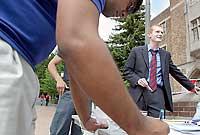
Young GOP activist works to shape party's future
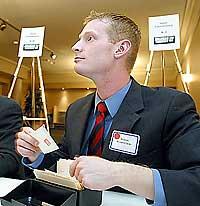
Schwitters is only 21. But he's already done dozens of these political events, speeches and fund-raisers here and in Washington, D.C.
"Everyone knows Aaron Schwitters," Kristina Morris, a fellow young activist, said recently.
Among Republicans, at least, that's no exaggeration.
In fact, you know Aaron, too, or a kid like him. The young political junkie. You went to high school with him, or maybe college.
The University of Washington political science major reads several newspapers every day, but struggles to name a single interest outside of politics. Instead of taking classes this past semester, he interned with the state Republican Party. He's on every board and committee and is always asking for your vote for something or other. When everyone else is casual, he's business casual.
For a few people like Schwitters — head of Washington's Students for Bush and political director of the King County Republicans — politics has tapped them on the shoulder, aroused both their sense of idealism and their limitless ambition.
"I'm Catholic, and people talk about priests being chosen. Politics is that way. Some people have it in their blood," said Chris Vance, chairman of the state Republican Party, elected to the state House at 28 and the King County Council at 31.
Schwitters' life at 21 might seem a tad bizarre, spending free time blowing up balloons and handing out bumper stickers. Indeed, only about one-third of Americans in his age group typically vote in a presidential election, though turnout could be higher this year.
But he's building a political résumé and acquiring allies that he hopes will lead him to elective office soon.
Campaigns often have been defined by the rabid young activists who gave them energy. Barry Goldwater's young anti-Eastern Establishment types screamed for him in 1964. Legions of young anti-war activists fueled Eugene McCarthy's 1968 candidacy and eventually helped drive Lyndon Johnson from the White House. Ronald Reagan's 1980 college volunteers now dominate the Republican Party.
And this year, thousands of Howard Dean volunteers — so-called Deaniacs — traveled to Vermont and then Iowa to join his campaign.
The reason, to a large degree, is economic: The Aaron Schwitters of the political world provide the cheap labor both parties rely on to gather stray votes.
"They sleep on the floor, eat pizza for breakfast, lunch and dinner, work 14 hours for no money, and they think it's fun," Vance said.
"They give you infectious energy and create the campaign bubble that makes you believe," said U.S. Rep. Adam Smith, D-Tacoma, who worked on his first campaign at 17 and was elected to the state House at 25.
Schwitters spent a recent sunny day like he spends most: strategizing, meeting, driving, networking, volunteering. What he doesn't do is spend a lot of time talking about taxes or how to fight the war on terror. His real passion is not issues or ideology, but the mechanics of competitive politics — and November victories. In a fashion, his political career was launched back in third grade. By some reasoning mysterious even to Schwitters, he decided Bill Clinton must not be elected president of the United States. He told all his classmates.
"They were uninterested. I think I was just that weird kid talking about politics."
He also remembers arguing with his teacher about whom was lying: Clarence Thomas or Anita Hill. He doesn't remember hearing the substance of Hill's allegations, which would have been inappropriate for a 9-year-old. But he does remember listening on the radio to the Senate roll-call vote on Thomas' nomination to the U.S. Supreme Court in 1991. He loved the drama.
He began doing grass-roots political work while at Bishop Blanchet High School in North Seattle, working for the King County Republicans.
Since then, Schwitters has developed expertise in raising money and organizing. At a recent King County Republican meeting, he helped raise $1,000 in a couple of hours for the College Republicans, of which he just ran unsuccessfully for president (Bill Clinton lost his first election, too, when he ran for Congress in 1974.)
Schwitters created a database of UW graduates who are Republican Party donors. The state party was ecstatic.
The College Republicans traditionally have grappled over the future of the party. Karl Rove's successful campaign for executive director of the national College Republicans in the early '70s led him into the arms of the Bush family.
"It's important to be able to walk into a room and know people," Schwitters said.
Schwitters has an easy style around people. He knows names and cracks jokes, usually about himself. Of the 500 most influential Republicans in the state, he's familiar with all of them, and has befriended many, he said.
His cellphone was his Rolodex until he lost it recently. "It crippled me," he said.
At the state Republican Party headquarters in Southcenter, they doled out responsibilities for the state party convention in May. Schwitters, a volunteer, would recruit and direct other College Republicans to be sergeants-at-arms. His days would start at 6 a.m., as they often do, and end in receptions at midnight or later.
He loves it. He knows nothing else, and doesn't seem to see anything extraordinary about a life consumed with nothing so much as politics. Sports? Nope. Music? Didn't listen to any in the car. Movies? No. Friends? Mostly Republicans.
In high school, Schwitters was a U.S. Senate page — a kind of personal assistant — for Slade Gorton during a summer. He then worked for U.S. Rep. Jennifer Dunn, answering phones, doing legislative research, chasing down lost Social Security checks and the like. When he interned in Dunn's Mercer Island office, he took the bus an hour each way from Ballard, where he grew up.
"He was always wanting more to do. He seemed more like staff than an intern," said Shannon Flaherty, a former Dunn staffer who now works for the Republican leadership.
Then it was off to the Bush White House, where he interned in the office of Ken Mehlman, who now runs the Bush re-election effort. Schwitters had to leave the Beltway, where he was a student at Catholic University, because it became too expensive. He's working his way through college with the help of his apolitical mom, a registered nurse who raised him on her own.
"I don't know where it comes from," his mother, Jackie Schwitters, said of her son's political wiring. "You love your kids and encourage them."
Schwitters has his life planned out. Law school two years after college. A run for state House soon after that.
Among the small group of young Republican activists, there are some intense rivalries. The party is struggling with its self-image in the face of its own electoral successes, its young activists trying to define what it will be in 10 years, and wrestling over who will control it.
Schwitters has all kinds of Republican bona fides — thousands of volunteer hours, money raised, votes found. But he's also unafraid to laugh at himself or his party.
On his way to meet another young comer working on a congressional campaign, Schwitters jokes, "I hate rich Republicans. I hate rural Republicans."
Knowing the party relies heavily on those demographic groups, he raises the question and answers it with characteristic wit: "What kind of Republican does that make me? A middle-class urban Republican."
Of which, as he knows full well, there are few in the city of Seattle.
Of his own future: "Hey, get some experience, start an oil company, use your dad's connections and become president," he said with a laugh, quickly adding that his devotion to President Bush is almost filial.
But he has his own critique of Republicans: The party, he said, has too many pessimists and culture warriors. He believes Republicans would be better off talking optimistically about free-market policies at home and democracy abroad.
Mostly, he's a pragmatist who hates to lose.
"You can't do anything if you don't win."
J. Patrick Coolican: 206-464-3315 or jcoolican@seattletimes.com